Resonance Shifts A Plague Tale From Stealth to Full Combat
After closing out Amicia and Hugo de Rune’s story in 2022’s A Plague Tale: Requiem, Asobo Studio has taken a bold swing with its follow-up. Resonance shifts the Plague Tale series away…
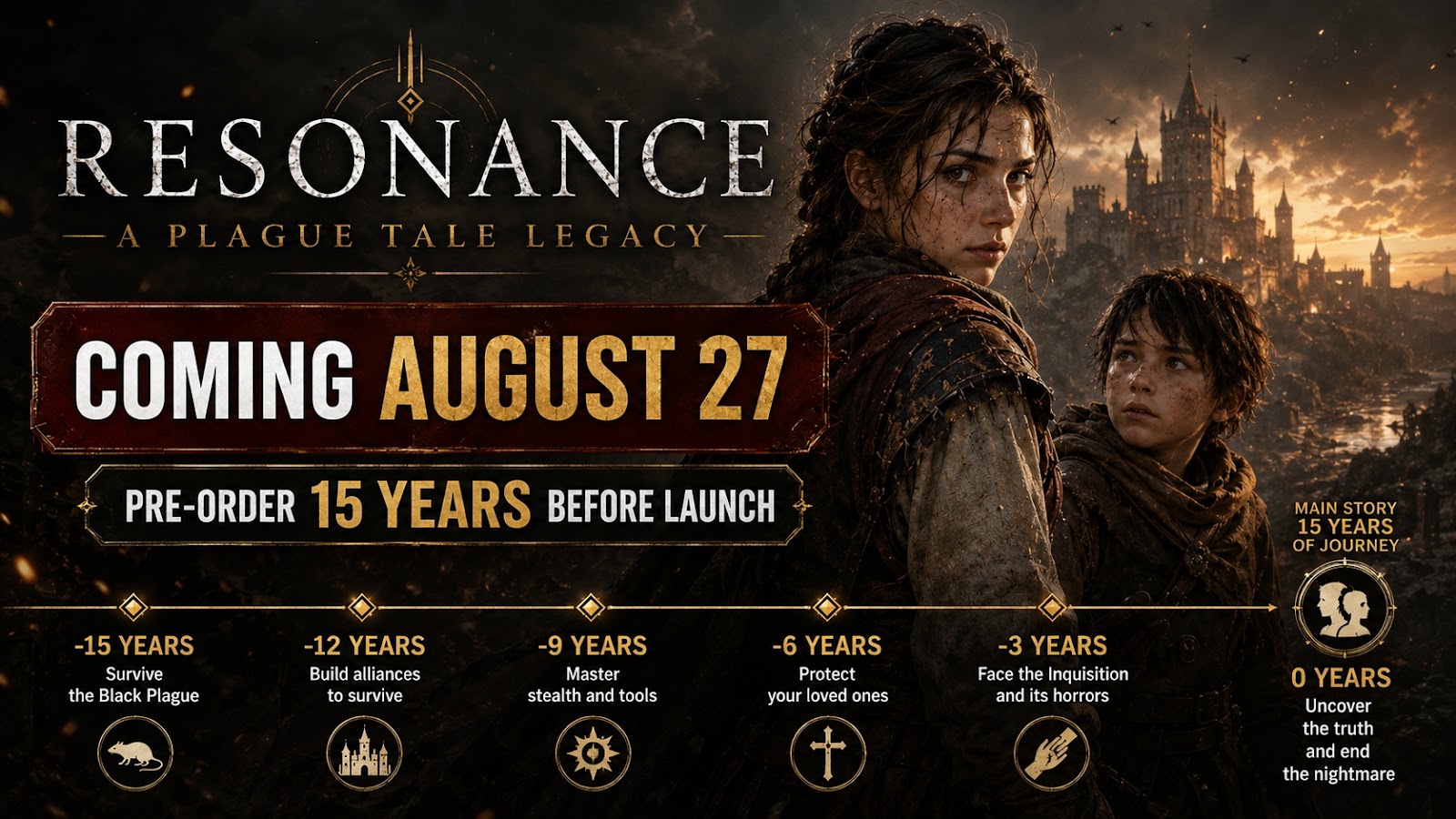
After closing out Amicia and Hugo de Rune’s story in 2022’s A Plague Tale: Requiem, Asobo Studio has taken a bold swing with its follow-up. Resonance shifts the Plague Tale series away from the stealth-survival identity that defined its first two entries and into full combat-driven action, under the title Resonance: A Plague Tale Legacy, launching August 27, 2026.
From a Fleeing Girl to a Trained Fighter
The clearest change is the protagonist herself. Where Amicia was built around avoidance and hiding from threats, Sophia — a smuggler wielding a sword and dagger — comes in as a fully trained fighter from the start. Resonance is a prequel set in 1334, fifteen years before the events of Requiem, following Sophia as she uncovers her connection to the ancient history of the Prima Macula, a journey that leads her to the mythical island of the Minotaur.
Game director David Dedeine has said the team wanted to “keep things fresh” and preserve their creative spark after seven years working with Amicia and Hugo, prompting the decision to reinvent both the protagonist and the core gameplay systems.
A Plague Tale Combat: A System Built From the Ground Up
Building out A Plague Tale’s combat wasn’t a small undertaking, given the series had never featured a serious fighting system before. Asobo Studio grew its team to roughly 80 developers over nearly four years of development specifically to support a combat-driven protagonist. The result includes parries, dagger counters, and brutal finishing moves — with several critics comparing the feel to a mix of Assassin’s Creed and Tomb Raider.
The game also introduces a dual-timeline mechanic, letting players move between the Middle Ages and the Minoan era, where actions taken in the past can directly affect the present. This adds another layer to both puzzles and combat encounters. Notably, Asobo has stated it did not use generative AI anywhere in the game’s development — a stance the studio has spoken about publicly as a matter of principle.
A Plague Tale: Requiem vs. Resonance — How Different Are They?
Putting A Plague Tale: Requiem side by side with Resonance reveals differences across nearly every dimension. Requiem and the original Innocence were built around evasion, hiding from enemies, and a protagonist whose survival depended heavily on her environment and the people around her. Resonance flips that entirely — Sophia can walk straight into a fight with confidence, backed by a far more agile moveset than any previous lead in the series.
Some outlets have gone as far as saying Resonance bears very little resemblance to the original A Plague Tale formula, underlining that this isn’t a minor tuning pass but a full reset of the series’ core gameplay identity. That said, one thing that remains consistent is the emphasis on environmental puzzles and narrative depth, which several reviewers still rank among the game’s strongest elements, right alongside the new combat system.
Asobo’s Calculated Bet on a New Direction
This shift represents a calculated risk for Asobo Studio. Longtime fans may have expected another stealth-survival experience in the mold of the first two games, but early reviews have largely responded positively to the new direction — particularly praising how fluid Sophia feels to control, with some outlets calling the new combat system the best the series has ever felt.
Conclusion
Resonance: A Plague Tale Legacy makes clear that Asobo Studio is willing to abandon a proven formula to push the series in a new direction — trading stealth for full combat, adding a dual-timeline mechanic, and weaving in the myth of the Minotaur along the way. It’s a sharp departure from Requiem, and it remains to be seen whether this new direction becomes the long-term future of the A Plague Tale series.