Resonance: A Plague Tale Legacy Launches August 27 — A Prequel Set 15 Years Before the Original
After a long wait from series fans, Resonance: A Plague Tale Legacy finally has an official release date: August 27, 2026, launching on PS5, Xbox Series X/S, and PC, with day-one availability…
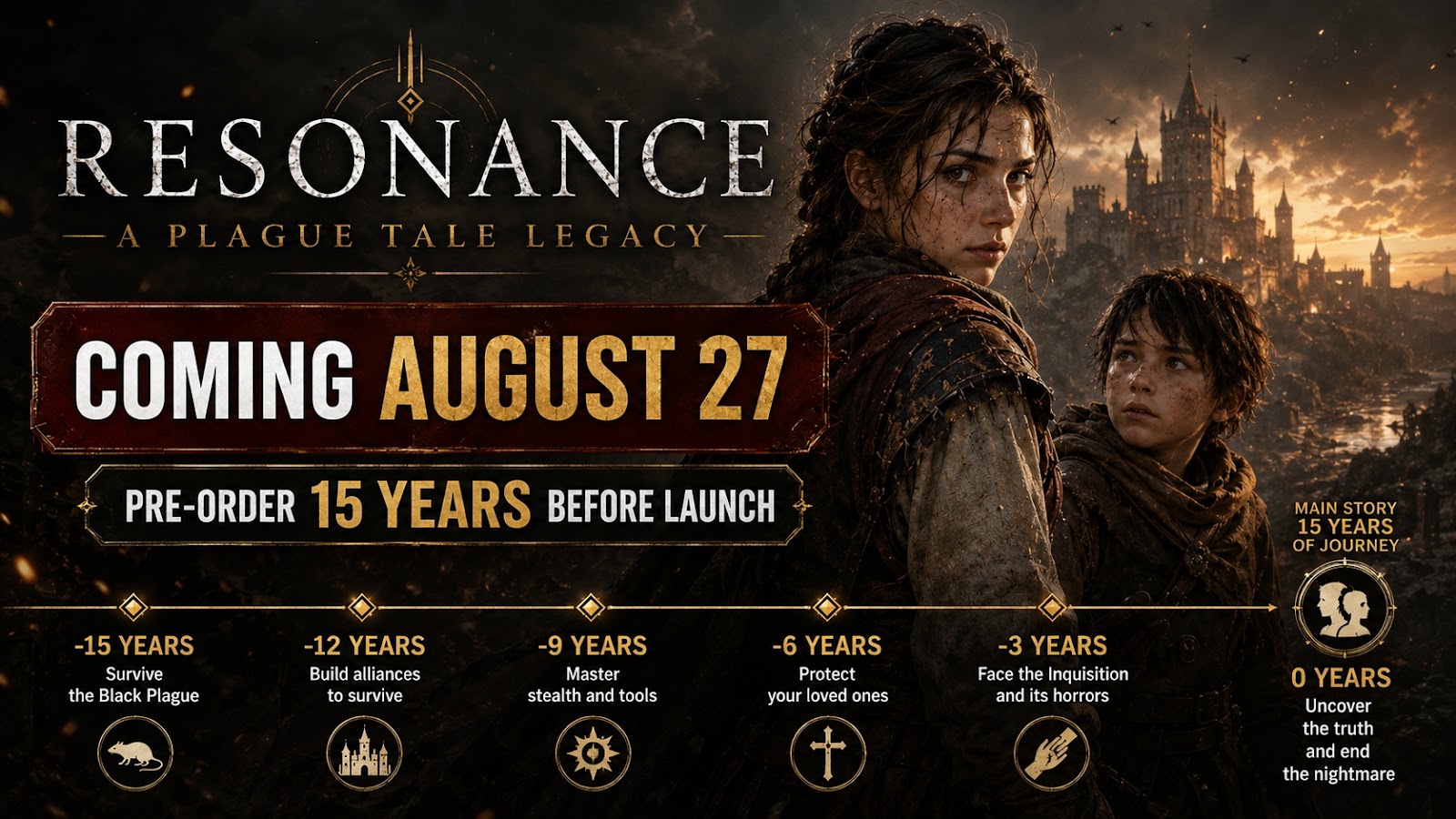
After a long wait from series fans, Resonance: A Plague Tale Legacy finally has an official release date: August 27, 2026, launching on PS5, Xbox Series X/S, and PC, with day-one availability on Xbox Game Pass. This entry serves as a prequel set 15 years before the events of the original Innocence, and it arrives with sweeping changes to both story and gameplay that set it apart dramatically from previous entries in the series. This article rounds up details and media reactions from several outlets covering the game so far.
Story Overview: Back to 1333–1334
Resonance: A Plague Tale Legacy takes players back to the years 1333–1334, roughly 15 years before the events of Innocence. This time, players won’t be stepping into Amicia’s shoes — instead, the game follows Sophia, the thief character previously seen in Requiem. The story kicks off with Sophia fleeing pursuit from Venetian soldiers, eventually finding herself stranded on Crete Island in the Mediterranean Sea.
One of the clearest shifts in this entry is its central theme. Where earlier games leaned into the dark, rat-infested atmosphere of a French village, this installment instead trades that setting for the sunlit ruins of ancient Greek civilization — specifically the Minoan civilization — giving the series a genuinely fresh visual and tonal direction.
Resonance Sophia and the Parallel Timeline of Theseus
One of the most distinctive story mechanics in this entry is a condition called “Resonance” — a form of hallucination affecting Sophia that lets both her and the player shift into a parallel timeline set in ancient Greece. During those sequences, players take on the role of Theseus, the legendary hero who battled the Minotaur, the half-man, half-bull monster of myth. Crucially, actions taken during Theseus’s ancient-era sequences directly affect puzzle mechanics back in Sophia’s present-day timeline, tightly weaving the two storylines together throughout the game.
On the story’s core mystery, Sophia isn’t traveling to Crete to find a cure this time, unlike previous protagonists — she’s there to uncover the origin of the “Macula” curse, which turns out to be deeply tied to the island’s Minotaur legend.
A 180-Degree Gameplay Shift: From Stealth to Full Action
The single most talked-about change in this entry is a near-total reversal of the series’ core gameplay identity. Where earlier games leaned heavily on stealth mechanics, crafting systems, and escorting the young Hugo, this installment strips almost all of that away in favor of a full-on action game — something closer to a blend of Tomb Raider and Assassin’s Creed.
Sophia’s combat is fast-paced, built around sword and dagger fighting, with a complete Parry, Dodge, and Counter/Execute system. The game also uses color-coded enemy attack telegraphs, similar to many modern action games — yellow or red attacks, for instance, must be dodged and cannot be blocked. A new tool, the Grappling Hook, lets Sophia pull enemies in for finishing moves or to extend combos. There’s also a Limit Break system, where the finishing move changes depending on which weapon is currently equipped — the game features roughly eight collectible weapons to hunt down throughout the story.
On the progression side, a new Skill Tree lets players earn points through combat to unlock new abilities — such as throwing a parried enemy into another nearby foe — and skill points can be freely reset at any time without restriction.
Light-Based Puzzles and Vertical Exploration
Despite the massive combat overhaul, the puzzle-solving the series is known for remains present, just reimagined. Sophia’s key tool this time is a Sphere, functioning much like a flashlight, capable of firing beams of red, green, and blue light that reflect off mirrors and prisms scattered throughout the island’s ancient ruins to solve door-opening puzzles.
Level design has also grown considerably more complex, adding proper vertical exploration — cliff climbing, hanging and swinging traversal, and navigating labyrinths noticeably more intricate than anything seen in earlier entries.
Boss Battles and New Threats
This entry adds a much more fleshed-out boss battle system than previous games, featuring both sword duels against elite warriors and encounters with monsters lurking in the darkness. While the game is keeping full details under wraps for now, speculation points toward encounters tied to both the series’ signature rat swarms and the mythological Minotaur woven into this entry’s central story.
What the Media Is Saying
Coverage and reactions from several outlets offer a range of interesting perspectives. Thai channel The Moof focused on the Greek mythology referenced throughout the game — King Minos, the architect Daedalus, and the origin of the Minotaur — highlighting just how much historical research the development team clearly put in, while also breaking down the Macula parasite’s underlying theory in detail.
GamingBolt zeroed in on cataloging more than 15 changes from Requiem, pointing out that the UI/HUD looks noticeably busier this time around, now including health bars and combo meters, as a direct result of the game’s shift into a full action title — while the crafting system has been significantly scaled back.
IGN, for its part, came away especially impressed with the combat system, calling this the smoothest and most enjoyable A Plague Tale game to play in the series’ history. The alternating rhythm of roughly 10-minute puzzle sequences with intense combat encounters was singled out as giving the game’s overall pacing an especially well-balanced feel.
Meanwhile, ENFANT TERRIBLE published a 14-minute uncut gameplay video, showcasing the game’s striking visuals, back-and-forth dialogue between Sophia and her companion Lenny, and a tense tunnel chase sequence against a monster — proving the game still retains the series’ signature horror and tension despite the gameplay shift.
Final Verdict: A Prequel That’s Willing to Change
Resonance: A Plague Tale Legacy represents a bold step for the series, deliberately abandoning its old identity — stealth mechanics and child-protection sequences — in favor of becoming a full action game, while telling its story through two intertwined timelines that weave ancient Greek mythology directly into the Macula mystery at its core. While it’s a dramatic departure from previous entries, the strongly positive reactions from multiple outlets regarding the combat system and storytelling pacing suggest this is a game well worth keeping an eye on ahead of its official launch on August 27, 2026. And notably, Xbox Game Pass subscribers will be able to jump straight in on day one without needing to purchase the game separately.